How to Create a Content-Led Go-To-Market (GTM) Strategy for Startups and Established Companies

Before you sell, your audience needs clarity. They need to know the problem you solve and the value you bring. That understanding comes from consistent, strategic communication, and that is where a Go-To-Market (GTM) plan makes the difference.
A strong go-to-market (GTM) plan brings together communication, promotion, and sales. All three are important, but communication is the foundation. It shapes how your product is understood, believed in, and remembered.
Without it, even the best campaigns or sales efforts struggle to gain traction.
A content-driven go-to-market framework uses content to build awareness, earn trust, and shape how people see your product before and after launch. It replaces guesswork with structure and turns marketing into a system that builds momentum over time.
When handled this way, content becomes more than promotion. It becomes the bridge between your product and the market, the reason people listen, engage, and eventually buy.
What Makes a GTM Plan Different From Regular Marketing
Most people think of marketing as the work that keeps a business visible. It is what drives growth once a product already has a place in the market. Marketing focuses on ongoing engagement through daily activities such as social media posts, blog articles, newsletters, and campaigns that maintain awareness and trust.
A go-to-market plan, on the other hand, focuses on entry. It defines how you will introduce your product, position it, and capture early attention within a specific audience. It aligns your vision, story, audience, and channels around a single launch goal.
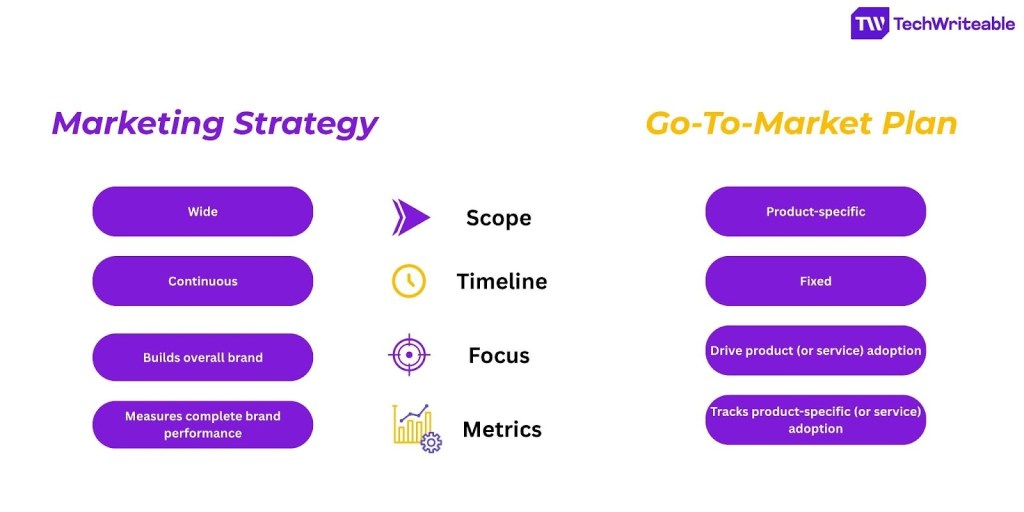
You need a GTM plan when something changes. That could mean:
- launching a new product or feature,
- entering a new market or region,
- repositioning your brand, or
- targeting a new customer segment.
Each of these moments requires clarity and coordination. A GTM plan gives you the structure to manage that change with precision. It helps you identify the right channels, craft the right message, and build early momentum before launch.
Stage 1: Define Your Product Vision and Market Positioning
Every effective go-to-market strategy begins with clarity. Before you create content or plan campaigns, you need a defined product vision and clear positioning. Once those are out of the way, you can go on to create a story that connects your idea to the right audience.
Product Vision
Your product vision sets direction. It explains what your product aims to achieve, the change it brings, and why it matters in the market. It should be simple enough to explain in one sentence but strong enough to guide every message and decision that follows.
Example:
“To help small businesses simplify customer communication by creating one platform for messages, email, and automation.”
A clear vision provides focus. It aligns your team, your marketing, and your customers around a shared understanding of what success looks like.

Market Positioning
Your market positioning shapes perception. It defines where your product fits, who it serves, and what makes it different from competitors. To clarify your positioning, answer these core questions:
Positioning Statement Template:
With our product [product name],
We help [target audience],
Who need [what they require or want],
Which can help them [achieve the desired result],
By providing [the benefits or features that make it possible].
Standing out from the competition, our product is [what makes it unique or difficult to replicate].
Example:
With our product TW CRM,
we help early-stage SaaS startups,
who need to manage customer outreach efficiently,
which can help them increase retention and close deals faster,
by providing an easy-to-use, data-driven CRM platform.
Standing out from the competition, our product is built specifically for startups with smaller teams and faster growth cycles.
This statement creates a clear message that positions your product accurately in the minds of your audience.
Stage 2: Understand Your Audience and Insights
Once your vision and positioning are clear, the next step is to understand the people you are trying to reach. Your go-to-market strategy will only work if you know who your audience is, what they care about, and where they spend their time.
Define Your Ideal Customer Profile (ICP)
Your Ideal Customer Profile, or ICP, is a detailed picture of your best-fit customer. It helps you focus your efforts on people who are most likely to buy, stay loyal, and benefit from your product.
To define your ICP, start by asking:
- Who are they? Identify their role, company size, or demographic details.
- What do they need? Understand the challenges or goals your product helps them solve.
- Why does it matter to them? Clarify the motivation behind their interest or purchase.
- Where can you find them? Note the platforms, communities, or spaces where they spend time.
The clearer your ICP is, the easier it becomes to create content that speaks directly to them and attracts the right attention.
Turn Insights Into Storytelling
Understanding your audience is not just about data. It is about empathy. Your story should reflect how your audience thinks, talks, and makes decisions, and should also communicate to them in language they understand.
You want to avoid technical terms or product-heavy messaging, and instead of focusing on features, show outcomes. For instance, replace “AI-powered automation” with “tools that help you save time and get more done.”
When your message mirrors your audience’s challenges and aspirations, it builds trust. People connect with stories that sound familiar and reflect their reality. This connection makes your brand memorable and believable.
Pay Attention to Channels That Matter
Knowing your audience also means knowing where to reach them. Observe the platforms they use most and the type of content they engage with there. Some audiences prefer in-depth articles or videos, while others respond better to quick insights on LinkedIn, Reddit, or X.
These insights will guide your distribution plan later in the process. When you know where your audience spends time and how they consume information, your marketing becomes more precise and efficient.
Understanding your audience is not a one-time exercise. It is an ongoing process of listening, observing, and refining. The more closely you align your story and communication with real audience insights, the stronger your go-to-market strategy becomes.
Recommended Tools for Audience Insights
Understanding your audience is an ongoing process of listening, observing, and refining. The right tools make it easier to gather these insights and keep your strategy sharp:
- SparkToro: Identify where your audience spends time online and what influences them.
- Google Trends: Track search interests and how they evolve across regions or topics.
- AnswerThePublic: Discover real questions your audience asks to inspire relevant content.
- Reddit and LinkedIn Communities: Observe authentic discussions to learn audience pain points.
- Social listening tools (Brandwatch, Mention, Hootsuite): Track sentiment, mentions, and engagement trends in real time.
The more closely you align your story and communication with real audience insights, the stronger your go-to-market strategy becomes.
Stage 3: Build Foundational Content for Each GTM Stage
A content-led go-to-market strategy works best when it is designed as a complete journey, not a one-time launch. From the first landing page visit to the final community engagement, every piece of content should guide your audience forward: building awareness, trust, and conviction at each stage.

Think of your content as the path that moves your audience from discovery to advocacy. Each stage of that journey requires different types of content with a clear purpose and measurable goal.
Awareness: Create the First Impression
The journey begins with discovery. Your audience is learning about the problem and exploring new ideas. This is where your product story meets their curiosity.
Key content:
- A website or landing page that clearly states the problem and your solution.
- Blog posts and opinion pieces that define industry challenges or trends.
- Short videos or infographics that simplify complex ideas.
Purpose: Help your audience identify the problem and see why it matters now.
Consideration: Build Credibility and Trust
Once your audience understands the problem, they begin to compare options. Your content should now focus on building confidence and showing why your solution stands out.
Key content:
- Guides, templates, or whitepapers that offer practical solutions.
- Case examples or customer stories that prove success.
- SEO-optimized blog content that answers “how” and “why you.”
Purpose: Demonstrate expertise and position your brand as a credible solution.
Activation: Help Users Experience Value
At this point, your audience is ready to act but needs clarity on how your product fits their needs. Your goal is to make it easy for them to take the next step.
Key content:
- Product walkthroughs, demos, or tutorials.
- Onboarding sequences or explainer videos.
- Feature spotlights that connect benefits to real use cases.
Purpose: Remove hesitation and show users how quickly they can see results.
Retention and Advocacy: Keep Momentum and Build Community
Once users adopt your product, the focus shifts to retention and advocacy. Continued communication builds loyalty, while recognition turns customers into promoters.
Key content:
- Case studies that celebrate customer wins and measurable results.
- Product update posts, newsletters, and founder notes that show progress.
- Community-focused content such as AMAs, contests, or co-created stories.
Purpose: Keep users engaged, reinforce value, and build long-term relationships.
Stage 4: Plan Distribution Like a GTM Campaign
Creating strong content is only half the work. Getting it in front of the right audience is what turns communication into growth. The right distribution plan ensures your content reaches people who need to see it, engages them at the right moment, and provides feedback you can learn from.
Your approach to distribution depends on your company’s stage and resources. Early-stage teams often focus on organic and shared channels, while more established ones add PR and paid campaigns to scale visibility. Regardless of stage, the goal is the same: to distribute content with intention, not routine.
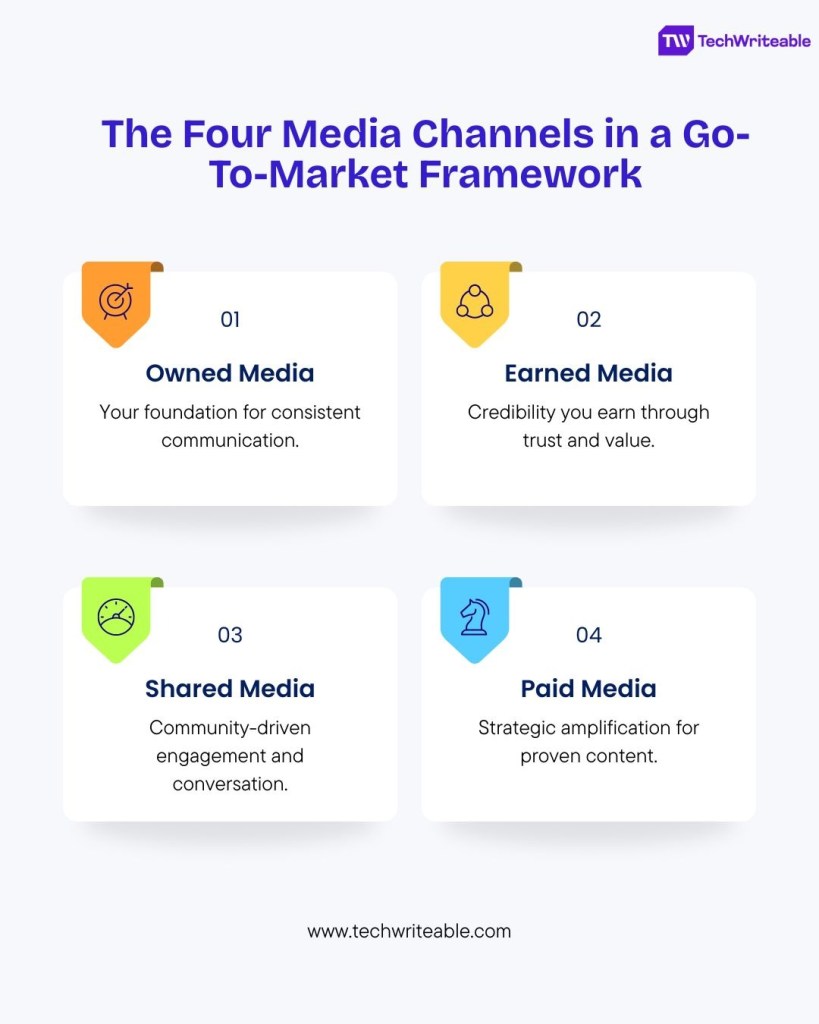
Owned Channels: Build Long-Term Control
Owned channels are the platforms you control completely, such as your website, blog, newsletter, and community spaces. They form the foundation for consistent communication and long-term growth.
How to use them effectively:
- Publish articles and updates that help your audience understand your mission and progress.
- Use your newsletter to build relationships with early supporters and potential customers.
- Create a community space or series that keeps engagement active after launch.
Owned channels are vital for early-stage teams because they provide stable visibility even when social reach or ad performance changes.
Earned Media: Use Credibility as Leverage
Earned media includes any coverage or mention from trusted sources such as press features, guest posts, podcasts, or newsletters that already reach your audience.
How to use them effectively:
- Pitch story ideas, research insights, or founder perspectives to relevant publications.
- Collaborate with journalists or editors who focus on your industry.
- Use PR strategically to build credibility around milestones like funding, partnerships, or launches.
For startups, small features in niche blogs or newsletters can be more valuable than mainstream attention. For growing companies, larger media placements help strengthen authority and reach.
Shared Platforms: Build Awareness Through Conversation
Shared platforms such as LinkedIn, X (Twitter), YouTube, and Reddit allow your brand to engage directly with your audience. They are where opinions form and where your story gains personality.
How to use them effectively:
- Repurpose your main content into short, platform-friendly posts or threads.
- Join conversations and reply to comments to build genuine connections.
- Partner with creators or communities that already influence your target audience.
For early teams, shared platforms are a cost-effective way to build visibility. For scaling brands, they become powerful spaces for thought leadership and ongoing engagement.
Paid Support: Amplify What Already Works
Paid campaigns are most effective when they build on proven organic performance. They help expand reach, test new messages, and speed up visibility for high-performing content.
How to use them effectively:
- Start small by promoting top-performing organic posts to test conversion potential.
- Use retargeting ads to re-engage visitors who already showed interest.
- Choose cost-effective platforms like Twitter or sponsored newsletters before scaling to larger channels like LinkedIn or Google Ads.
Paid efforts should support your strategy, not drive it. They work best when they amplify what already connects with your audience.
Distribution gives your content momentum. A strong GTM system connects owned, earned, shared, and paid channels into one flow, each reinforcing the other.
Start with what you control, build credibility through earned opportunities, grow community through shared platforms, and use paid distribution to amplify your strongest messages.
The best GTM strategies evolve with your company’s stage, ensuring that your reach grows as your story does.
Stage 5: Use Analytics to Drive Early Validation
Another important element of a good go-to-market strategy is the feedback loop. Early validation helps you test assumptions, refine messaging, and confirm whether your content and positioning truly resonate with your target audience.
The goal at this stage is not to measure everything, but to measure what matters.
When you treat your content as a testing ground, analytics become your first proof of traction. They show you what messages attract attention, what formats drive engagement, and what value propositions convert interest into action.

Track Meaningful Signals
Instead of focusing only on vanity metrics like views or impressions, pay attention to signals that show genuine audience interest and intent.
Key metrics to track:
- Sign-ups: Subscriptions to your newsletter, early access list, or waitlist.
- Engagement: Comments, shares, and replies that show active interest.
- Click-throughs: Movement from top-of-funnel content to deeper assets like guides or demos.
- Conversions: Early sales, pilot program sign-ups, or demo requests.
Each of these signals helps you see not just who is paying attention, but who is ready to take the next step.
Turn Analytics Into Insight
Numbers alone do not tell the story. The goal is to understand why your content performs the way it does and use that insight to guide the next move.
How to do this effectively:
- Compare performance across content types. If tutorials or case studies perform better than thought pieces, it may signal your audience is closer to buying than learning.
- Analyze referral sources to identify which platforms bring the most qualified leads.
- Track engagement patterns over time to spot emerging topics or questions worth expanding into larger campaigns.
Analytics should help you make decisions, not just create reports.
Validate Before You Scale
Before investing heavily in paid promotion, use small experiments to test what resonates. Early content performance is one of the fastest, lowest-cost ways to validate your positioning and message.
Practical examples:
- Create a landing page with a single content offer such as a guide or newsletter, and track sign-ups to see if the value proposition attracts attention.
- Test different headlines, visuals, or CTAs through A/B testing.
- Use heatmaps or scroll analytics to understand which parts of your page hold attention and which lose it.
- Run short organic or low-budget paid tests to compare performance before committing to larger spend.
Validation is about direction, not perfection. Small, data-driven iterations now prevent wasted time and ad spend later.
Recommended Tools for Early Validation
You can start small with lightweight tools that provide clear insight without overcomplicating setup:
- Google Analytics: Track traffic, conversions, and on-site behavior.
- Hotjar or Microsoft Clarity: Visualize engagement with heatmaps and user recordings.
Typeform or Tally: Capture qualitative feedback through quick surveys or exit questions. - HubSpot or ConvertKit: Manage email sign-ups and see which content drives the most conversions.
- LinkedIn or X analytics: Monitor engagement quality on social content.
Validation is not a one-time test. It is a continuous cycle of publishing, measuring, learning, and improving. When you use analytics to validate your content, you do more than track performance. You also build confidence in your message before scaling your efforts.
By the time you increase your budget or expand campaigns, you will already know what resonates, what converts, and what drives genuine market traction.
Stage 6: Build a System for Consistency and Scale
Once you start seeing traction, the next challenge is maintaining consistency as you grow. Scaling content output without losing quality requires structure. This is where systems, templates, and collaboration make a real difference.
A content-led go-to-market strategy works best when it runs on repeatable processes. When everyone knows what to create, when to publish, and how to measure results, execution becomes easier and quality stays high.
Create Repeatable Workflows
Build simple systems for ideation, production, and distribution.
- Ideation: Keep an ongoing content backlog informed by analytics, customer feedback, and keyword insights.
- Production: Define clear roles and deadlines using a shared calendar or project management tool such as Notion, ClickUp, or Trello.
- Distribution: Use scheduling tools like Buffer or Later to maintain consistency across platforms.
The goal is not to produce more content, but to create efficiently while keeping standards high.
Repurpose and Multiply Value
Repurposing helps you get more mileage from every piece of content. You can turn one idea into multiple formats. For example, a long-form blog can become a short LinkedIn post, infographic, or video explainer.

This approach saves time, extends reach, and keeps your message consistent across channels. I’ll recommend using a “pillar to micro” framework.
Start with one in-depth piece of content each month (like a guide or case study), then break it into smaller, channel-friendly versions that sustain visibility over time.
Collaborate for Fresh Perspectives
As you scale, collaboration becomes key. Partner with niche creators, industry experts, or community members who can bring new insights and expand your reach.
Invite contributors for guest posts, joint webinars, or newsletter features. Collaboration adds diversity to your content while keeping it aligned with your brand message.
All put together, a system is what keeps good content from becoming chaotic. With the right workflows, repurposing strategy, and collaborative mindset, your team can grow output without losing clarity or authenticity.
Consistency also compounds over time. The more structured your process becomes, the more scalable your marketing engine gets, allowing your message to reach further without losing its voice.
If you are planning a product launch or refining your marketing strategy, I would be happy to help you build a content-led go-to-market plan that fits your goals and stage of growth. Here’s a link 🔗 to visit my website, and book a call.

[…] Read more: How to Create a Content-Led GTM Strategy for Startups and Established Companies […]
Wow! This is so detailed. Can’t wait to come back and finish it up